![]() |
![]() |
| Rev. Adam Clayton Powell Jr. 1937-1971 |
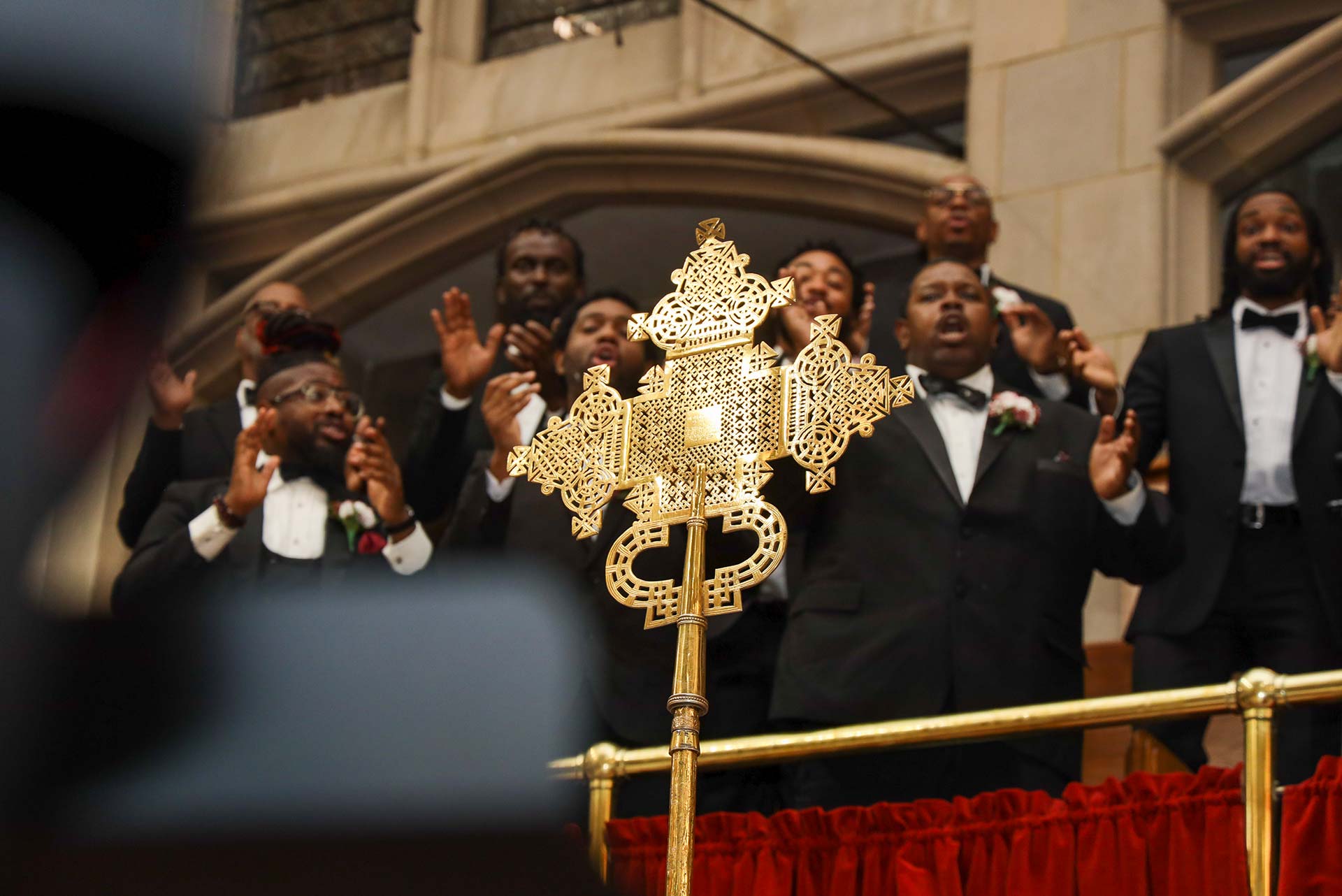
Rev. Adam Clayton Powell, Jr. receives, on behalf of the church, a golden Coptic cross from Haile Selassie, emperor of Ethiopia (1954). |
| "The Intrepid Preacher-Politician…" Adam Clayton Powell, Jr. |
|
| Born in 1908, the only son of Mattie Fletcher Powell and Adam, Sr., Adam Powell, Jr. succeeded his father at the Abyssinian Baptist Church, serving as pastor from 1937 until 1971. Having already begun his service to the Church in 1930 as an assistant pastor and director of Abyssinian's kitchen and relief operations that fed and clothed thousands of Harlem's needy during the Depression, the Rev. Powell, Jr., (affectionately known to many as "Adam"), confidently assumed the responsibilities of pastor. With the assistance of the Rev. David Licorish, the younger Powell led during his pastorate from 8,000 to 10,000 who were affiliated with Abyssinian, the self-proclaimed "church of the masses," to wider avenues of witness and service. Adam Clayton Powell, Jr. successfully combined the Christian message of justice and equality with the militant oratory of a leader of a political movement of African-American among all classes who desired liberation and equal rights. As a city councilman - elected in 1941 - and as the Congressman of the 22nd District - elected in 1944 and serving for fourteen terms in the House of Representatives - and as a pastor, Adam was a part of the Black Revolution. He successfully wielded power as the chairman of the House Committee on Education and Labor, managing federal legislation in regard to the needs of African-Americans and generating or amending nearly sixty public laws to benefit Blacks, the aged, handicapped, Hispanic-Americans, women and poor whites in areas such as fair employment practices, public education, public school aid, manpower development and training, discrimination against women, an increased minimum wage and the war on poverty. Yet, he challenged his congregation continually to be a "light" and to be "salt of the earth." As he put it: "This...is an unparalleled moment for the black man's church -- to really be the leadership of this people's revolution. The black man's church has always been a church of the masses. I think it is time for the masses in the church to insist...that their leadership of the pew and the pulpit should be vitally a part of the Black Revolution." Thus, under Adam Clayton Powell, Jr., Abyssinian Baptist Church not only had full-time weekday activities for members and the Harlem community (including a Protestant education release time program and welfare service through the Church's Board of Service), fulfilled its commitment to world-wide missions supporting the Suen Industrial School in West Africa, and provided consistent spiritual nourishment for all seeking Jesus, but also engaged in boycotts and picketing for the elimination of racial discrimination and for the establishment of better health care and broader opportunities for African American people. Ill and a veteran of the struggle, Adam Clayton Powell, Jr. retired in 1971 and died in 1972. |
|